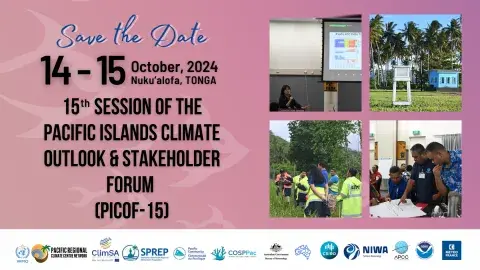
The Pacific Islands Climate Outlook Forum (PICOF) is a bi-annual meeting that provides a platform for dialogue and knowledge exchange between the providers and users of climate information. PICOF-15 will enable representatives from Pacific Island Countries and Territories (PICT) and climate providers to review Pacific climate and ocean conditions including impacts and extreme climatic events from May to October 2024 and issue outlooks for key climate parameters, including tropical cyclones, for the next six months (November 2024 - April 2025). Such forum will also allow users to provide feedback and support the providers of climate information to formulate response strategies.
Expected Outcomes:
- Improved understanding of climate and ocean monitoring and outlook information and better understanding of the outlook and outlook confidence/skill for the region for the period in question
- Produce a regional statement containing climate, ocean and tropical cyclone outlooks for November 2024 to April 2025 which NMHSs can use as guide to develop their national statements
- PICOF-15 Report
- Assist regional stakeholders and NMHSs where possible to improve climate and ocean bulletins as well as media and social media content better meeting primary stakeholder and community needs
Key messages:
- The tropical Pacific is currently ENSO-neutral. While not meeting thresholds for a La Niña event, ocean and atmospheric patterns across the region are currently La Niña-like. La Niña or La Niña-like patterns are the most likely outcome for remainder of 2024. Climate models indicate that should La Niña develop, it would be relatively short-lived with a return to ENSO-neutral in early 2025.
- The 2024/25 southwest Pacific tropical cyclone (TC) season begins on 1 November 2024. TCs have occurred out-of-season in the months of May, June and October but such occurrences are rare during La Niña events.
- For the coming season, normal or above normal TC activity is likely west of and including Vanuatu. East of Vanuatu, normal to below normal TC activity is likely. It is important to keep in mind that it does not take a direct hit or severe TC to cause considerable damage or life-threatening weather.
- The rainfall outlook over November 2024 to January 2025 is consistent with La Niña conditions. Below normal rainfall is likely between Nauru and the Phoenix Islands (Kiribati), Marquesas (French Polynesia), Tuvalu, Tokelau, Northern Cook Islands. Above normal rainfall is favoured between southern Papua New Guinea (PNG) and Southern Cook Islands. In the northwest Pacific above-normal rainfall is also likely between Palau and eastern Federated States of Micronesia (FSM). Confidence in this outlook is very high in the central equatorial Pacific and moderate in the subtropical Pacific.
- Above normal air temperatures are favoured in regions excluding the central and eastern equatorial Pacific.
- Sea level is favoured to be higher than normal around PNG, FSM, the Republic of the Marshall Islands (RMI), Palau, Solomon Islands, New Caledonia and southern part of Tonga. Below normal sea level is favoured around Kiribati, southern parts of Tuvalu, Samoa, northern Fiji, northern Tonga, Niue, parts of Cook Islands, parts of French Polynesia and the Pitcairn Islands.
- Higher than normal sea level is favoured near the Solomon Islands, PNG, Palau, FSM, RMI, New Caledonia and southern Tonga. In regions where higher tides are also predicted the combination higher tides and above normal sea levels may elevate their risk of coastal inundation.
- Coral bleaching alerts are present for PNG, FSM, RMI, Palau, and Nauru, and forecast through to December.
Documents
Details
Date
Location
 Tonga
Tonga
Registration including morning tea
Group photograph
Responsible
SPREP
Opening and Setting the Scene
- MC – Terry Atalifo
Opening prayer
- Mr. Naneasi Havea, TMS
Opening remarks
- SPREP Rep (Mr. Salesa Nihmei, Climate & Meteorology Adviser)
- WMO Rep (Mr. David Hiba, Acting RA V President)
- Tonga Government (Ms. Seluvaia Ilolahia, Acting Director - TMS)
Meeting objectives
- PICS Panel/RCC Management Committee Chair
Session 1: ENSO Status and Outlook
Including highlights from Global Seasonal Climate Update (GSCU)
Responsible
NIWA, BOM, Meteo-France, NOAA, University of Hawaii, APCC, SPREP, SPC
Session 2: Looking Back - Review and Evaluation of May to October Climate Outlook
- Atmosphere
Overview of April to October state of the climate, plus evaluation of the last PICOF outlook - Ocean
Overview of April to October state of the ocean, plus evaluation of the last PICOF outlook - Tropical cyclones
Overview of the TCs over May to October - Impacts - Overview of significant weather and ocean events over the last six months
- Micronesian region
- Melanesian region
- Polynesian region
Responsible
(First 3 subsections, 15 minutes each, 4th subsection 25 minutes)
- NOAA, University of Hawaii, BOM, SPC, SPREP, NIWA
- NOAA, University of Hawaii, BOM, SPC, SPREP, NIWA
- NOAA, University of Hawaii, BOM, SPC, SPREP, NIWA
- Palau, Solomon Islands and Cook Islands (8 minutes each)
Lunch
Session 4: Looking Forward – Monthly and Seasonal Outlooks for November 2024 to April 2025
- Atmosphere
PICOF outlook and RCC Node for LRF individual model/MME guidance and skill comparison - Ocean
PICOF outlook and RCC Node for LRF individual model/MME guidance and skill comparison - Tropical cyclones
PICOF outlook and RCC Node for LRF individual model/MME guidance and skill comparison
Responsible
(25 minutes each)
- NIWA, BOM, Meteo-France, NOAA, University of Hawaii, APCC, SPREP, SPC
- NIWA, BOM, Meteo-France, NOAA, University of Hawaii, APCC, SPREP, SPC
- NIWA, BOM, Meteo-France, NOAA, University of Hawaii, APCC, SPREP, SPC
Afternoon Tea
Session 5: Looking Forward Long-Term
A brief review of climate change projections for variables of interest to Pacific communities: In October 2024, these will be air temperature and rainfall
Responsible
CSIRO, UGCRP, BoM and SPREP
Session 6: Summary of proceedings & next steps
Responsible
PICS panel chair
Morning Tea
Session 7: Production of National Statements
Using a pre-prepared template RCC-N members will assist the member countries produce national statements based on information from Day 1 and from other sources of high-quality climate monitoring and prediction information.
Responsible
All RCC-N members
Lunch
Session 8: Review of PICOF-15 and past PICOFs
Open discussion
This is an opportunity for the NMHSs, RCC-N members and WMO representatives to review and propose changes to PICOF if required
Responsible
Terry Atalifo, John Marra and Simon McGree
Session 9: Introduction to GEDSI and Inclusive early warning early action: checklist and implementation guide
Responsible
Patricia Mallam
Afternoon tea
Session 10: Working with Vulnerable Groups
- Co-exploring needs
- Enabling climate services for with persons with disabilities
- Considerations for co-producing climate information products
Responsible
- Katabwena Tawaka
- Pacific Disability Forum
Summary of proceedings, next steps and PICOF closing
