Forum(s) Objectives:
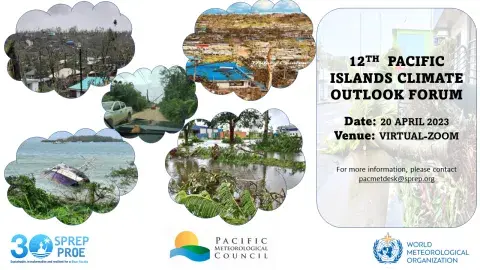
Ben Noll (NIWA) outlined the overall objectives of the PICOF 12:
- To discuss and produce objective, user-relevant regional climate and ocean outlook guidance in real time.
- Support member NMHSs produce national climate and oceans information for their national stakeholders, with the ultimate aim of reducing climate-related risks and support sustainable development for the coming season in sectors of critical socioeconomic significance.
Specific Objectives of the meeting include:
- build partnerships among NMHSs and Pacific RCC Network members, to facilitate the uptake and use of climate and ocean products and services in Pacific RCC-N member countries.
- compare seasonal and sub-seasonal forecast guidance and discuss how these are produced in terms of accuracy, utility, weaknesses and strengths.
- present, discuss, and summarise the climate and ocean conditions for the last six months and model outlooks for the next six months.
- provide long-term monitoring of and present long-range projections for selected variables, as climate change has had and will continue to have a significant impact in the Pacific region.
- discuss how NMHSs are currently accessing and assessing the available guidance, making them nationally-relevant, tailoring them for specific end users, and disseminating them to users;
- continue capacity building/human resource development activities for the NMHSs, particularly on sectoral application aspects of seasonal and sub-seasonal predictions.
Expected Outcomes:
- Better understanding of climate driver (e.g. ENSO) behaviour, climate (e.g. rainfall) and ocean anomalies over November 2022 to April 2023.
- Improved understanding of climate, ocean and tropical cyclone outlooks over May to October 2023, reasons for differences between model outlooks and model confidence for the outlook period.
- Improved understanding long-term trends and climate change projections for selected variables including how climate change may influenced Pacific climate in the last 6 month and outlook for the next 6 months.
- Production of a regional statement summarising the ENSO state, tropical cyclone, climate and ocean patterns.
Documents
Details
Date
Location
 Virtual
Agenda
Registration and communications testing
Meeting procedures
Responsible
SPREP to coordinate and provide all supporting details and documents prior.
Session 1: Opening and Setting the scene
- Opening prayer (Mika Perez, Tokelau)
- Opening remarks (Tagaloa Cooper, PMDP, SPREP)
- Opening remarks (Henry Taiki, WMO)
- Meeting objectives (Ben Noll, NIWA)
- Group photo
Session 2: ENSO Update and Outlook
- ENSO status and outlook, and introduction to ENSO tracker: NIWA, BoM, Meteo-France, NOAA, University of Hawaii, APCC, SPREP and SPC (15 minutes)
- Including - highlights from Global Seasonal Climate Update (GSCU)
- Session 2 discussion (10 minutes)
Responsible
All PICOF are joint presentations. A representative from the agency in bold will deliver the presentation with support/input from the remaining agencies referenced.
Session 3: Looking Back - Review and Evaluation of November to April Climate outlook.
- Atmosphere
Overview of November to April state of the climate, plus evaluation of the last PICOF outlook:
NOAA, University of Hawaii, BoM, SPC, SPREP, and NIWA (15 minutes). - Ocean
Overview of November to April state of the ocean, plus evaluation of the last PICOF outlook:
NOAA, University of Hawaii, BoM, SPC, SPREP, NIWA (15 minutes). - Tropical cyclones
Overview of the TCs over November to April:
NOAA, University of Hawaii, BoM, SPC, SPREP, and NIWA (15 minutes). - Impacts
Overview of impacts over November to April:
NOAA, University of Hawaii, BoM, SPC, SPREP, and NIWA (15 minutes).
Session 3 discussion (20 minutes)
Session 4: Looking Back Long-Term: Status of key variables
A brief examination of long-term trends for variables of interest to Pacific communities: In April 2023, these will be air temperature and ocean acidification: NOAA, University of Hawaii, BoM (Air Temperature), SPC (Ocean Acidification), SPREP, and NIWA (20 minutes).
Session 4 discussion (10 minutes)
- Tropical cyclones and sea level at PICOF-10
- Rainfall and SST at PICOF-11
10 min break
Session 5: Looking Forward - Seasonal and Intra-seasonal Pacific guidance for May to October 2023.
- Atmosphere
PICOF outlook and RCC Node for LRF individual model/MME guidance and skill comparison:
NIWA, BoM, Meteo-France, NOAA, University of Hawaii, APCC, SPREP, and SPC (15 minutes). - Ocean
PICOF outlook and RCC Node for LRF individual model/MME guidance and skill comparison:
NIWA, BoM, Meteo-France, NOAA, University of Hawaii, APCC, SPREP, and SPC (15 minutes). - Tropical cyclones
PICOF outlook and RCC Node for LRF individual model/MME guidance and skill comparison:
NIWA, BoM, Meteo-France, NOAA, University of Hawaii, APCC, SPREP, and SPC (15 minutes)
Session 5 discussion (15 minutes)
Session 6: Looking Forward Long-Term
A brief review of long-term climate change projections for variables of interest to Pacific communities: In April 2023, these will be air temperature and ocean acidification:
CSIRO, UGCRP, BoM and SPREP (20 minutes).
Session 6 discussion (10 minutes)
Session 7: Closing
Chair: Summary of proceedings, feedback from participants.
Next steps: production of PICOF 12 Report and Statement.
